We couldn't read that link.Unrecognised profile URL
Something got mangled between there and here. Links do that. Nothing's broken on your end. You can still take the test yourself, or go poke at the simulator.The URL did not resolve to a known deficiency type. This is typically caused by truncation in transit. The screening test and simulator remain available.
Find out what you seeTake the screening test yourself Open the simulator
A shared view
This is how someone here sees the world.This simulates one recorded color vision result.
Before anything else: it's not black and white.Preliminary: this is not achromatopsia
That's the thing almost everyone assumes, and it's wrong. Colors are all still there. What's missing is the gap between some of them. Two colors you'd never mix up land in the same place and stay there. Press the switch and watch it happen to this page, wall and all.The common assumption is a total loss of color perception. In fact all three cone classes remain functional; one is shifted, which collapses the perceptual distance between specific hue pairs. The comparisons below apply that transform to familiar images.
Everything on this page is about to change, including the wall behind it. Nothing here is a mock-up of the effect, it is the effect.The transform is applied to the entire document, background included, using the same matrices throughout rather than an approximation of the result.
That's it. That's the whole difference, and it doesn't switch off.The rendered state above is the simulated percept. Toggle it back to compare the two directly.
Things that stop workingRepresentative failure cases
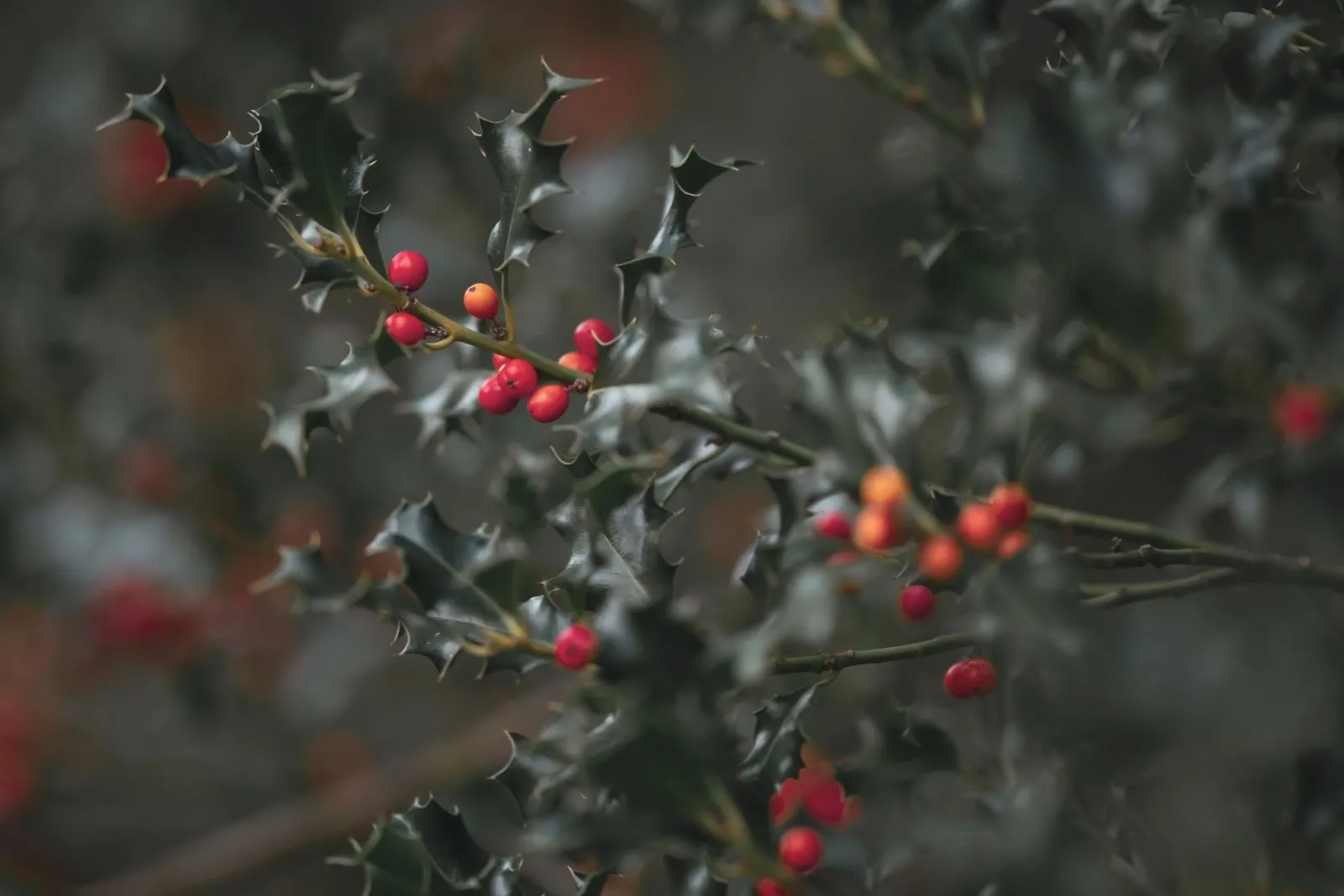
The picture as it was made, with nothing done to it. This is the one everybody else is looking at.Unmodified source image. No transform applied.
The same picture with the selected kind of colour vision applied to it. If you have that kind of vision yourself, this will look almost identical to the one before it, and that is the correct result rather than a fault: your eyes are already doing this, so doing it twice changes very little.The source image after the Machado transform for the selected type and severity. Note that for a viewer who has that deficiency the transform is close to idempotent, so the visible difference from the unmodified image is small.
Every dashed box is around something whose colour is genuinely different from the colour touching it. You are receiving both as the same colour, so without the box there is nothing there to find. The dashes are us pointing. Nothing in the photograph itself is dashed, which is how you can tell them apart from it.Each marked region is quantised to a colour that converges with an adjacent colour under the selected transform. Marks are dash patterns rather than fills or hues, so they remain distinguishable in every simulated mode including achromatopsia.
These are not the real colours, and they are not meant to be. Wherever two things looked identical to you a moment ago and look different now, that is a difference that was always there and never reached you. Nothing is being fixed and this is not what anything looks like. It is a way of showing you the size of the gap.False colour rendering. The residual between the original and the simulated percept is projected onto the preserved chromatic axes, restoring discriminability at the cost of colour fidelity. Not a corrective measure.
PhotoPhotographer: Sandra Beuck
01 Foliage
The berries do not disappear. Look again: they are right there, and they are the colour of dead leaves. Nothing is missing, so nothing looks wrong. That is the part that is hard to explain, and it is why ripe and rotten is a guess.Frugivory is the standard evolutionary account of primate trichromacy. Under a red-green transform the berries retain their full luminance contrast against the foliage and remain trivially detectable; what is lost is the chromatic signal that classifies them as ripe. The failure mode is misidentification, not omission.

Olive green and brown. For the most common kind of colorblindness these are not two colors that happen to look alike. They are one color with two names.Olive against mid brown. The M-cone shift that defines deuteranomaly removes very nearly all of the separation between them.

Teal against a plain grey of the same brightness. The teal gives up almost all of its color and settles into the grey, which is why people end up asking, out loud, whether that is grey or green.Protanomaly and deuteranomaly both nearly erase this difference, since teal's hue is exactly the information a shifted L or M cone stops carrying.
In practice
Same family as the common red-green kind, but reds take the hit here. A red car parked in shade can read as almost black to them, and red text on a dark background can disappear entirely. That's the part to watch for as the page shifts.Protanomaly: reduced L-cone sensitivity dims long-wavelength light in addition to compressing red-green discrimination, a luminance effect the more common deuteranomaly does not share. Prevalence is roughly 1% of men.
In practice
Their green sensitivity has drifted toward red, so the two crowd each other. A traffic light green can look almost white to them. Olive and brown can be the exact same color, not just similar. The wall behind this page is running through that same shift right now, so you're looking at it too.Deuteranomaly: a shifted M-cone peak compresses the perceptual distance between green and red. It is the most common deficiency, affecting roughly 5% of men. Discrimination is reduced; overall color perception is preserved.
In practice
This one is rare, and it doesn't split along red and green at all. Blue and green blur together for them, and yellow can wash out toward pink or grey.Tritanomaly: reduced S-cone sensitivity compresses blue-yellow discrimination. Unlike the protan and deutan forms it is not X-linked, and it occurs at similar rates in both sexes.
In practice
This is the rare condition people assume everyone with colorblindness has: color barely registers at all, and the world reads mostly as light and dark.Achromatopsia: near-total absence of functioning cone cells, leaving vision reliant on rods alone. Prevalence is around 1 in 30,000, far rarer than any form of anomalous trichromacy.
Find out what you seeTake the screening test yourself Try it on your own photos